Box-shaped furniture
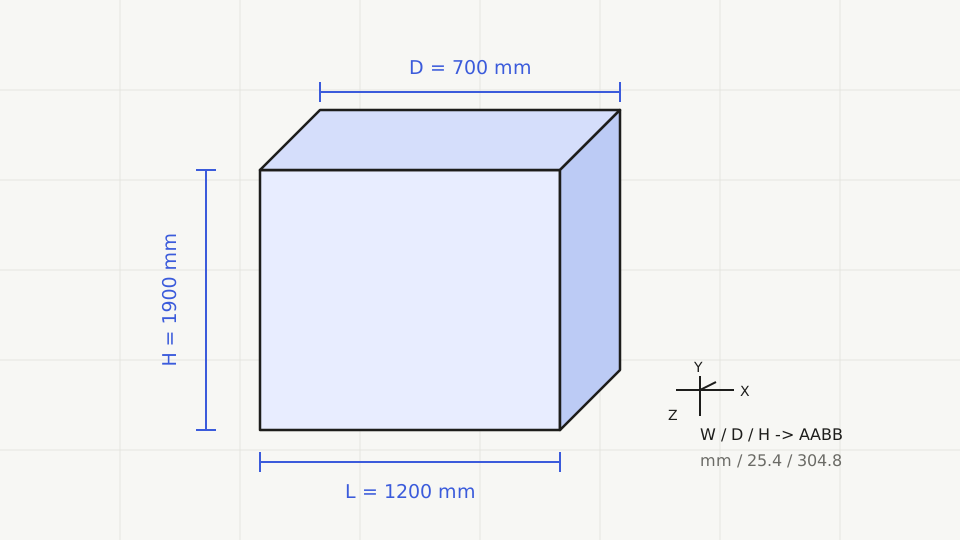
Sofas, wardrobes, cabinets, desks, washing machines and fridges can be entered when you can supply three outer dimensions of the item as it will be carried.
Enter real measurements. The engine computes six orientations against a clear doorway aperture and a static room volume, then returns one explained verdict with its limits stated.
Outer bounding-box dimensions in the selected unit.
Fills example dimensions for this type. They are suggestions, not your measurements.
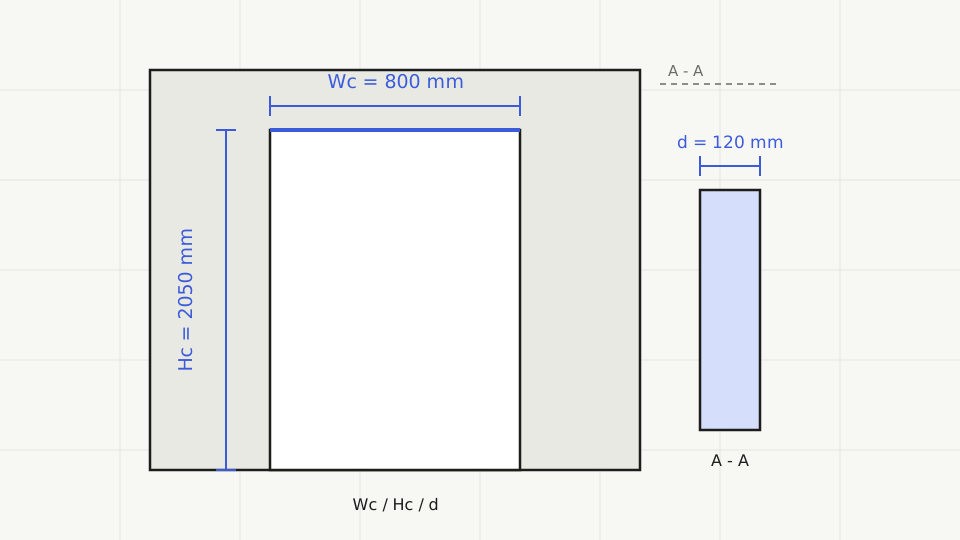
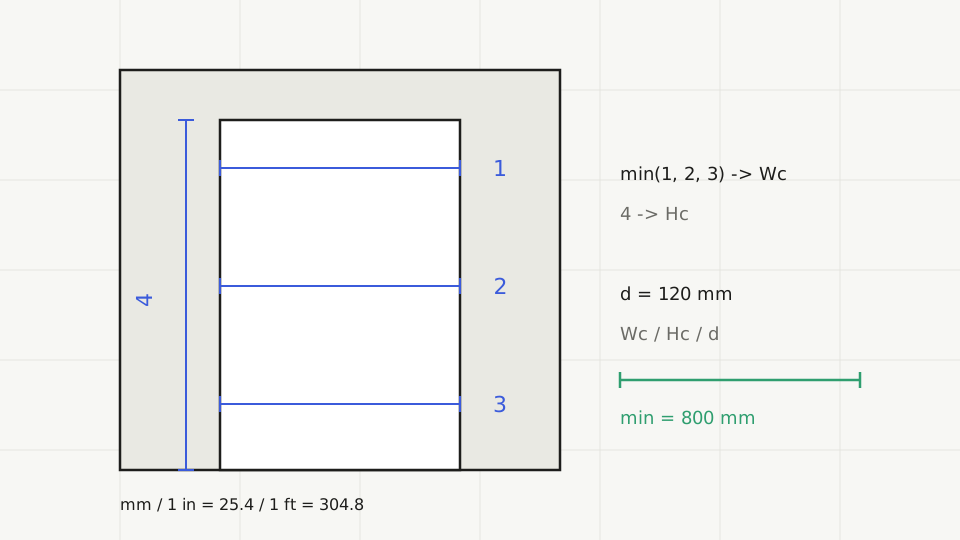
Use NET clear opening, not the outer frame size.
Optional. Leave blank if you did not measure it.
Interior width, length and ceiling height.
Corridor width
The current engine does not model corridor width, so corridor turning is not analysed.
Unit changes the display only; the physics stays in millimetres.
Optional extra operating margin applied to both doorway axes.
Drag the furniture in the 3D view, or use the axis controls for exact offsets.
Mesh, aperture, room envelope and labels all come from one result object.
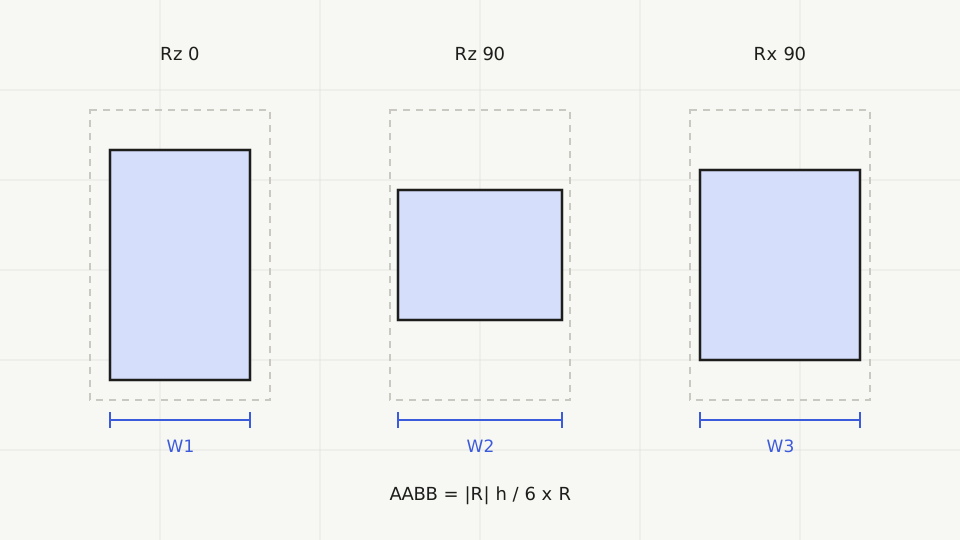
The blue wireframe is the bounding box of the selected posture — the box the engine actually measured, not the furniture surface. Only the six axis-aligned postures are modelled; arbitrary-angle rotation is not.
All tested checks pass with operating margin, and one posture satisfies both the doorway and the room.
Doorway section
PASS
Room volume
PASS
The selected posture passes the doorway section check.
DOORWAY_SECTION_PASS
The selected posture fits the static room volume.
ROOM_FIT_PASS
| Required | Available | Remaining | |
|---|---|---|---|
| Doorway clear width | 800 mm | 900 mm | +100 mm |
| Doorway clear height | 750 mm | 2000 mm | +1250 mm |
| Room width | 800 mm | 3000 mm | +2200 mm |
| Room length | 1800 mm | 4000 mm | +2200 mm |
| Room height | 750 mm | 2600 mm | +1850 mm |
Required projection against the available clear opening.
No numeric conflicts were found.
Rectangular bounding boxes only; real furniture shape and deformation are not modelled.
BOUNDING_BOX_ONLY · does not change the verdict
Only six axis-aligned postures were tested; no continuous-angle search was run.
AXIS_ALIGNED_POSES_ONLY · does not change the verdict
The carrying route, stair turns and corridor segments are not simulated.
PATH_NOT_MODELLED · does not change the verdict
Door leaves, handles, handrails and other obstacles are not modelled.
DOOR_LEAF_AND_OBSTACLES_NOT_MODELLED · does not change the verdict
Rotation within the frame depth is not simulated.
FRAME_DEPTH_ROTATION_NOT_MODELLED · does not change the verdict
Moving or turning the object inside the room is not simulated.
ROOM_PATH_NOT_MODELLED · does not change the verdict
Drag the furniture in the 3D view, or use the axis controls for exact offsets.
Position feedback is a static geometric check. It is not a transport-path simulation and never changes the fit verdict.
Fit verdict is unchanged by position
Offset from default: 0 / 0 / 0 mm
No boundary intersection at this position
SECTION_ONLY
These metre values are read back from the scene payload, not recomputed in the component.
| Oriented AABB (m) | mm | |
|---|---|---|
| Furniture local box (m) | 0.800 × 0.750 × 1.800 m | 800 mm × 750 mm × 1800 mm |
| Oriented AABB (m) | 0.800 × 0.750 × 1.800 m | 800 mm × 750 mm × 1800 mm |
| Clear aperture (m) | 0.900 × 2.000 × 0.180 m | 900 mm × 2000 mm × 180 mm |
| Room envelope (m) | 3.000 × 2.600 × 4.000 m | 3000 mm × 2600 mm × 4000 mm |
Projected section per posture
| Posture | Door | Room | Both | Section W | Section H | Depth |
|---|---|---|---|---|---|---|
| Upright | Yes | Yes | Yes | 800 mm | 750 mm | 1800 mm |
| Upright · quarter turn | Yes | Yes | Yes | 750 mm | 800 mm | 1800 mm |
| Lengthwise | No | Yes | No | 1800 mm | 750 mm | 800 mm |
| Lengthwise · quarter turn | Yes | Yes | Yes | 750 mm | 1800 mm | 800 mm |
| On side | Yes | Yes | Yes | 800 mm | 1800 mm | 750 mm |
| On side · quarter turn | No | Yes | No | 1800 mm | 800 mm | 750 mm |
The geometry engine treats one item as a single rectangular box with a length, a width and a height. It does not classify products, and it does not model curved or soft shapes.
Sofas, wardrobes, cabinets, desks, washing machines and fridges can be entered when you can supply three outer dimensions of the item as it will be carried.
Enter the outer size in the state you intend to move. A folded, rolled or disassembled item has different dimensions and needs its own measurement.
Curved surfaces, soft deformation, detachable legs and irregular outlines fall outside the model. The result is a bounding-box comparison, not a shape-accurate fit.
The preset values in this tool are illustrative sample inputs, not measured furniture specifications.
All dimensions are stored in millimetres. Changing the display unit changes labels only; the physical geometry stays identical.
Outer length, width and height of the item. Millimetres, centimetres, inches and feet are accepted, with 1 in = 25.4 mm and 1 ft = 304.8 mm.
Clear width and clear height mean the net opening between the innermost fixed surfaces, not the door leaf size. Frame depth is optional; leaving it empty is recorded as a limitation.
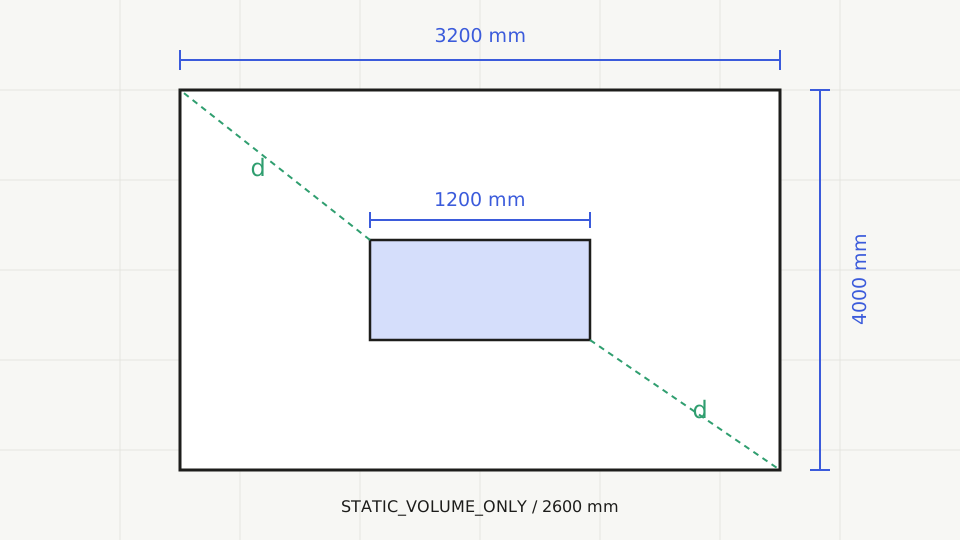
Width, length and height of a static rectangular room volume. The room check compares the oriented box against this volume; it does not simulate a carrying route.
Posture selects one of six axis-aligned orientations. Extra clearance is an operating margin you require on top of a bare size match.
Parsing rejects thousands separators, unit suffixes, empty, zero, negative and non-numeric values rather than guessing.
The tool recomputes on every change. Work through the fields once, then read the verdict and the evidence tables.
Record the outer length, width and height of the assembled item in the state you will carry it.
Record the net clear width and height of the doorway. Add frame depth if you can measure it.
Enter room width, length and height, choose a posture, and set any extra operating clearance you require.
Check the overall status, the reason list, the six-pose matrix and the remaining clearances. Change one input at a time to see what drives the verdict.
The status is produced only by the geometry engine. The page never assembles a verdict from colours or from a single comparison.
Every tested local check passes with operating margin, and one posture satisfies both the doorway and the room.
The geometry is not definitively clear: a different posture is needed, a blocking limitation applies, or no single posture satisfies both checks.
At least one local check fails for every tested posture.
At least one input is invalid, so the engine returns a structured INVALID_INPUT failure and produces no geometric verdict.
The interactive 3D drag is a static-position preview. It reports its own gaps and collisions, and it never rewrites the overall status.
One normalised millimetre model feeds both the result and the 3D scene. Nothing on this page recomputes geometry independently.
Millimetres are the single canonical unit. The 3D scene converts to metres only at render time.
Each posture applies a 3 by 3 rotation matrix combined as Rz, Ry then Rx. The oriented bounding box is the absolute matrix multiplied by the local dimension vector.
The doorway check is a section-only comparison of the projected cross-section against the net aperture. The room check is a static-volume comparison against the rectangular room.
Any failing local check yields FAIL. Any conditional check, blocking limitation or absence of a single posture that satisfies both checks yields CONDITIONAL. Otherwise PASS.
Conflicts, clearances and limitations are reported from real box faces. A flush contact with zero clearance is reported, not silently treated as a pass.
Calculation version 2.0.0. No continuous-angle search is implemented.
Maintenance responsibility: These pages are maintained together with the calculation engine in this repository. A change to the geometry or verdict logic requires the published method statement and its automated checks to be updated in the same change. There is no separately credited editorial team and no external reviewer.
Read the full calculation method and concept definitions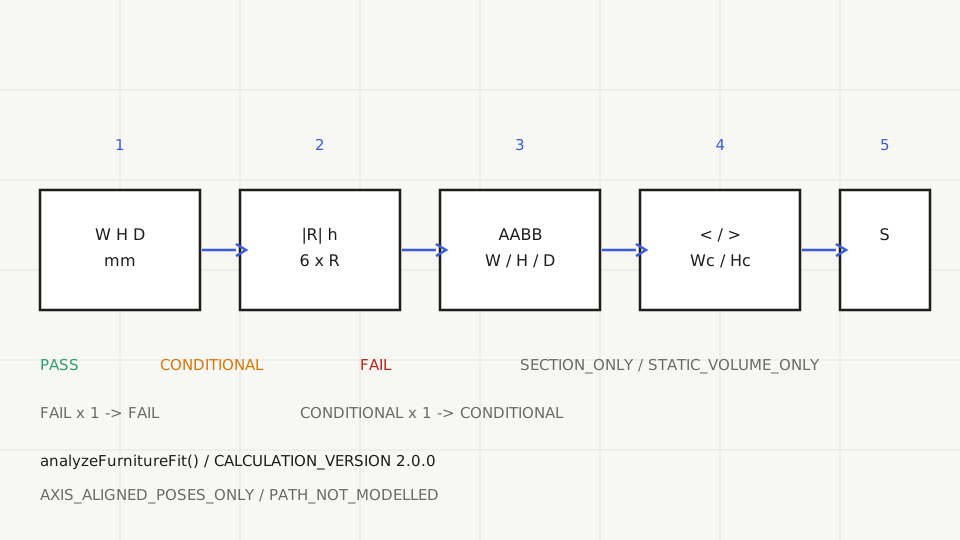
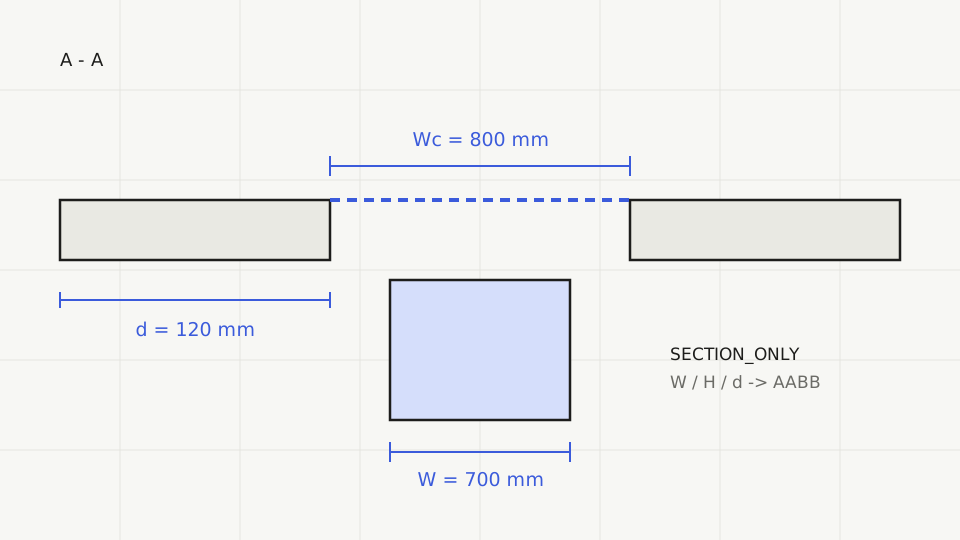
These are real limits of the current engine, not disclaimers added for appearance.
When the information is insufficient for a real judgement, the result must be CONDITIONAL and name what is missing.
Measure the clear net opening between the innermost fixed surfaces, meaning the width and height actually available to pass the object. The door leaf itself is not modelled.
A flush contact leaves no operating margin. The engine reports ZERO_CLEARANCE and returns CONDITIONAL instead of treating a zero-gap fit as a deterministic pass.
No. Six axis-aligned postures are tested. Continuous-angle search is not implemented in this version.
No. The drag is a static-position preview with its own gap and collision feedback. The overall verdict comes from the dimension-based engine and stays unchanged.
If it is left empty, the engine cannot assess rotation inside the frame depth. It records MISSING_FRAME_DEPTH as a limitation instead of inventing a value.
These pages are live on this site. Three are in-depth measurement and fit guides; the fourth is the technical 3D proof.
Three further guides cover sofa measurement, refrigerator clearance and bed-frame fit; each is linked from the related-pages section of every guide above.